
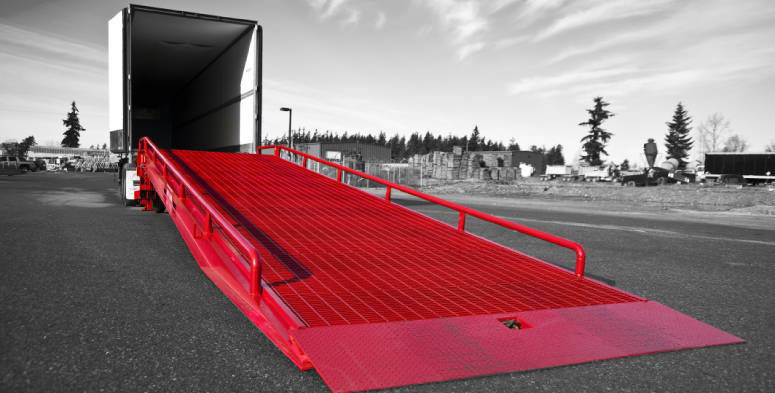
At Dura-Ramp, we’ve been engineering and manufacturing loading ramps for over 30 years, and one question comes up consistently among facility managers and procurement teams: why do some ramps hold up for decades while others fail ahead of schedule? The answer almost always comes back to how steel grade affects loading ramp longevity; not just rated capacity, but how the material performs under repeated industrial use, in real operating environments, over the full service life of the equipment.
What Steel Grade Actually Determines
Capacity ratings tell you what a ramp can hold. Steel grade tells you how reliably it holds that load over time, and whether it recovers after each cycle.
Two properties drive this:
- Yield strength: The threshold at which steel permanently deforms. Once a ramp exceeds its steel’s yield point under load, it doesn’t return to its original geometry. That deformation is cumulative.
- Tensile strength: The ultimate breaking point. High tensile strength matters, but yield strength is the more practical indicator of long-term structural performance under repeated use.
Higher-grade steels maintain structural integrity at higher stress levels. A ramp built with stronger steel handles the same load with less permanent strain per cycle, which directly extends service life in high-throughput applications.
Find out how ramp capacity ratings are determined.
Fatigue: The Failure Mode That Doesn’t Show Up on a Spec Sheet
Static load ratings don’t account for fatigue. A ramp that meets its rated capacity on day one can still fail prematurely if the steel degrades under cyclic stress over time.
Every load cycle (forklifts, pallet jacks, heavy carts, etc.) introduces stress into the structure. Steel has an endurance limit: a stress level below which fatigue failure won’t occur. The gap between a ramp’s operating load and that endurance limit determines how the material performs over thousands of cycles. Lower-grade steel narrows that margin considerably.
Fatigue failure typically initiates at high-stress concentration points: weld joints at the ramp lip, gusset connections along the under structure, and points where material thickness transitions.
This is why weld quality and base metal selection are inseparable. Our 100% welded steel construction is only as reliable as the steel it’s built from. When base metal grade drops, the heat-affected zones around welds become more susceptible to brittleness and early cracking, regardless of how skilled the welding is.
How Corrosion Interacts With Steel Grade
Environmental degradation is the other long-term threat to ramp integrity. Outdoor ramps face moisture, temperature cycling, and de-icing chemicals that accelerate surface oxidation. The critical issue isn’t cosmetic rust; it’s what rust does to effective steel thickness.
As corrosion progresses, it reduces the cross-sectional area of structural members. The same load now bears on less material. In lower-grade steels with higher carbon content, this process is faster and more damaging. Protective coatings such as paint or powder coating buy time, but they don’t eliminate the underlying susceptibility built into lower-grade steel.
For ramps operating in dock environments with frequent moisture exposure or road salt contamination, steel grade selection directly determines how long those protective finishes remain the primary line of defence versus how quickly the base metal becomes the problem.
Learn how to perform a loading ramp safety audit.
The Total Cost of Ownership Calculation
Procurement teams often evaluate ramps on acquisition cost. That framing understates the real financial exposure.
A ramp built from higher-grade steel in an engineered, fully welded structure costs more upfront. The relevant comparison isn’t purchase price; it’s cost per year of reliable service. When you factor in replacement frequency, unplanned downtime during ramp failure or removal, labour and rigging costs for changeout, and safety incident exposure during structural degradation, the economics shift substantially toward premium construction.
A ramp that operates reliably for 15 years in a high-cycle application delivers far lower annualized cost than one requiring replacement in year five or six, even if the initial price difference seems significant.
What to Ask Any Ramp Manufacturer
“Heavy-duty steel” is not a specification. When evaluating loading ramp suppliers, procurement and operations teams should be asking:
- What structural steel grade does your construction use, and why?
- How do your weld procedures account for the mechanical properties of that steel?
- What design features address stress concentration at high-load points?
- How does your construction perform in corrosive or outdoor environments?
A manufacturer with genuine engineering depth can answer these questions directly. Vague answers, or deflection to load capacity alone, are a signal worth noting.
Built to Last in Demanding Applications
Steel grade affects loading ramp longevity at every level: yield strength under cyclic load, fatigue resistance at weld joints, susceptibility to corrosion, and ultimately how long the structure performs as designed in demanding industrial use. At Dura-Ramp, our engineered, 100% welded steel construction reflects over 30 years of building ramps for the load cycles and operating conditions that end careers for lesser equipment. If you’re specifying ramps for a high-throughput facility and want to discuss construction standards for your application, call us at 1-877-820-1333.


