
Engineering loading ramps for demanding industrial environments has made forklift rollover prevention one of the most consequential topics in warehouse and dock operations. At Dura-Ramp, we know that preventing forklift rollover incidents on loading ramps starts with recognizing that operator behaviour and ramp design are both non-negotiable, as neither can compensate for failures in the other.
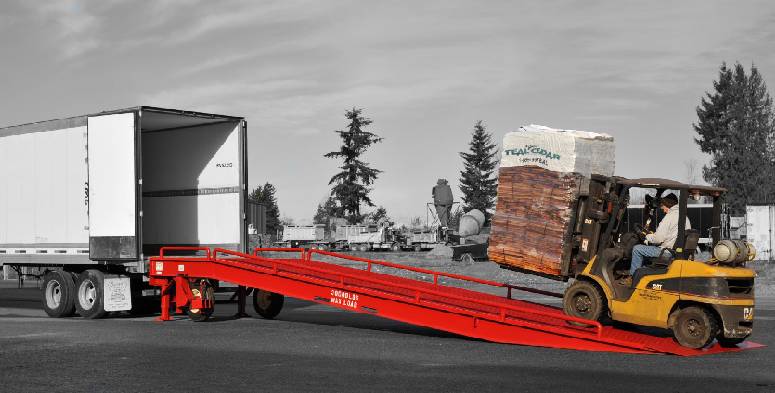
Learn some simple forklift ramp safety tips.
Why Ramps Increase Rollover Risk
Forklift stability depends on the vehicle’s centre of gravity staying within its stability triangle. On an incline, that centre of gravity shifts, and even moderate ramp angles amplify the consequences of a load positioned incorrectly or a turn executed at the wrong moment. The risk compounds when ramp surfaces are worn, improperly graded, or undersized for the equipment in use.
Ramp Design Features That Reduce Incident Risk
Properly engineered equipment eliminates hazards before operator error becomes a factor. When evaluating any loading ramp, these design elements are non-negotiable.
Traction Surface
Open-bar grating or punched steel decking provides grip under load in wet or high-traffic conditions. Smooth plate steel is not acceptable for forklift use.
Structural Capacity Ratings
Professional engineer-designed capacity ratings must account for the heaviest anticipated load, including the forklift itself. Underrated ramps flex under load, introducing instability.
Transition Plates
The interface between the ramp and the trailer floor must be smooth and secure. An abrupt edge or a shifting transition creates impact loads that destabilize carried product and the vehicle.
Ramp Width
The ramp must accommodate the full wheelbase of the equipment with adequate margin. Narrow ramps force operators into precision driving on an incline, an unacceptable risk in production environments.
Learn all about the gradient of forklift ramps.
Operator Procedures on Inclines
Ramp design does the foundational work, but operators must follow consistent procedures on every approach.
Load Positioning
Travel with forks pointed uphill when loaded, downhill when empty. This keeps the load’s weight distribution within the stability triangle.
No Turning on the Ramp
All directional changes must happen on flat ground before or after the ramp transition.
Controlled Speed
Momentum on a grade is a stability hazard. Slow, deliberate travel is the standard, not the exception.
Clear Sightlines
If the load blocks forward visibility, operators must travel in reverse with a spotter or use a mirror system.
Matching the Ramp to the Application
A ramp that is correct for one site may be entirely inadequate for another. Our custom manufacturing capability means ramp angle, width, deck length, and capacity are engineered to the actual equipment and dock height in use, including adjustable-height configurations for facilities handling variable trailer sizes. Off-the-shelf ramps rarely account for site-specific load requirements.
The Right Ramp is the First Line of Defence
Rollover incidents on loading ramps are preventable. Properly engineered equipment combined with disciplined operator procedures eliminates the conditions that cause them. If your current ramp configuration does not meet the demands of your operation, contact our team at 1-877-820-1333 to discuss a custom ramp solution engineered to your specific capacity and application requirements.


