
At Dura-Ramp, we work with procurement and operations teams across North America who get this wrong more often than they should: they select a loading ramp based on the forklift’s rated capacity, not its actual operating weight. The result is underspec’d equipment under real load conditions. Understanding how forklift weight affects ramp selection is foundational to sourcing the right industrial ramp for your facility, and it starts with knowing what numbers actually matter.
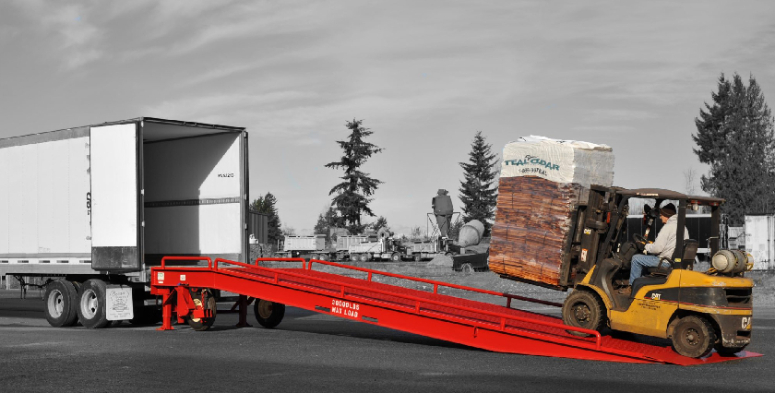
Rated Capacity Is Not the Same as Gross Vehicle Weight
A forklift’s rated capacity tells you how much it can lift. It says nothing about how heavy the machine itself is. Gross vehicle weight (GVW) includes the forklift’s own structural weight plus the counterbalance system, the mast, and whatever load is on the forks at the time of ramp travel.
A counterbalanced electric forklift with a 5,000 lb lift capacity can have a GVW well above 10,000 lbs when loaded. An IC pneumatic-tire forklift at the same rated capacity will carry a different GVW entirely. These distinctions matter because the ramp is supporting all of that weight simultaneously, distributed across a moving platform with dynamic load forces in play.
What to Pull From Your Equipment Specs
Before specifying any ramp, gather the following from your forklift’s data plate or manufacturer documentation:
- Gross vehicle weight (loaded and unloaded)
- Axle weight distribution (front and rear)
- Tire contact patch dimensions
- Maximum travel speed on inclines
These figures give you the actual load inputs, not approximations.
Learn how to prevent load shift during ramp operation.
Dynamic Load vs. Static Load Capacity
Ramp capacity ratings are typically expressed as static load ratings. Dynamic load conditions, such as a forklift in motion, decelerating, or turning at the top of a ramp transition, generate forces that exceed static weight. This is particularly relevant on portable or mobile ramp configurations where deck flex and approach angle amplify stress at connection points.
When sizing a ramp, apply a safety factor to the GVW before matching it against the ramp’s rated capacity. Industry practice calls for selecting a ramp rated well above the expected operating load, not one that just meets it on paper.
Approach Angle and Load Transfer
The ramp’s approach angle directly affects how load is transferred to the deck surface and edge connections. Steeper grades concentrate load forces at the base of the ramp and at the lip or dock connection point. Shallower grades distribute load more evenly across the ramp span.
For high-GVW forklifts, particularly reach trucks, heavy counterbalanced units, or rough-terrain forklifts, approach angles in the 7 to 15 degree range are standard. Grades steeper than that require explicit capacity verification against the actual loaded GVW, not the forklift’s lift rating.
Learn how to prevent forklift rollover incidents on loading ramps.
Forklift Type Drives Ramp Specification
Different forklift classes impose different demands on ramp design. The key variables are GVW, tire type, and drive configuration.
- Counterbalanced forklifts (IC or electric): High front-axle loads under load. Wide, reinforced deck surfaces and high lip-load ratings are essential.
- Reach trucks and order pickers: Lower GVW but narrow wheel base. Ramp width and wheel guide placement become the primary specification variables.
- Rough-terrain units and telehandlers: High GVW with pneumatic tires. Require heavy-duty structural ratings and may need longer ramp spans to achieve workable approach angles.
- Walkie stackers and pallet jacks: Lower GVW, but concentrated point loads from small-diameter wheels. Deck surface and load distribution matter more than raw capacity ratings.
Matching ramp specification to forklift class is not optional. A ramp adequate for a walkie stacker will not hold up under a loaded counterbalanced IC unit.
Ramp Width, Edge Load, and Wheel Tracking
GVW is the primary capacity input, but it doesn’t work in isolation. Ramp width must accommodate the forklift’s outside tire-to-tire dimension with enough clearance for controlled travel. Wheel tracking on a ramp that’s too narrow creates concentrated edge loading, which overstresses the ramp structure regardless of its rated deck capacity.
For most standard counterbalanced forklifts, ramp widths of 72 to 96 inches are typical. Wider equipment, including some rough-terrain units and certain reach truck configurations, may require custom-width ramp decks. At Dura-Ramp, we manufacture custom-width ramps to exact specifications, so equipment constraints don’t force a compromise on structural integrity.
Getting the Specification Right
Selecting the wrong ramp based on incomplete load data creates equipment failure risk and premature wear. The right process looks like this:
- Confirm GVW from the forklift data plate, loaded, not just unloaded
- Identify front axle load under maximum load conditions
- Determine required ramp width based on tire spacing plus clearance
- Match ramp capacity rating against GVW with appropriate load factor applied
- Verify approach angle against facility grade constraints
Every variable interacts. Change one, whether the forklift model, the load, or the grade, and the others require re-evaluation.
Match the Ramp to the Real Load
Ramp selection built on lift capacity ratings instead of actual GVW data is a shortcut that creates problems downstream. At Dura-Ramp, we have been manufacturing industrial loading ramps for customers across North America long enough to know which specification errors show up repeatedly. If you’re sourcing ramps for high-GVW forklift applications and want to work through the load calculations before committing to a specification, call our team at 1-877-820-1334.


