
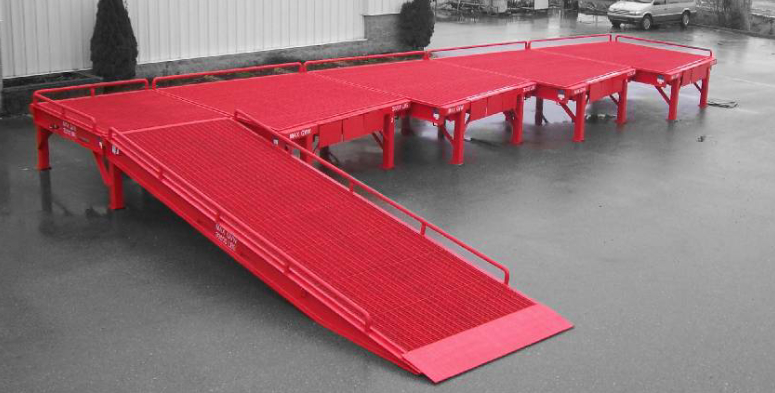
Ramp slope is one of the most consequential variables in loading dock safety, yet it rarely receives the engineering attention it deserves until something goes wrong. At Dura-Ramp, we’ve been manufacturing portable loading ramps for North American operations since 1990, and understanding how ramp slope affects forklift traction and safety is fundamental to every ramp we build. Get the slope wrong and no amount of operator skill compensates for the physics working against you.
The Physics of Slope and Forklift Stability
A forklift operates within a stability triangle defined by its three points of ground contact. On level ground, that triangle functions as engineered. As slope increases, the forklift’s effective centre of gravity shifts: rearward when ascending under load, forward when descending. Either condition moves the centre of gravity closer to the edge of the stability triangle.
The consequences are predictable:
- Ascending loaded: rear tipping risk increases as the load’s weight pulls backward relative to the incline
- Descending loaded: forward tipping risk increases, and steering response degrades as drive wheel contact pressure shifts
- Transition points: where the ramp meets the dock or ground, abrupt angle changes create sudden load movement that can exceed the forklift’s stability limits
Find out what loading ramp regulations all facility managers should know.
Industry Slope Standards
OSHA 1910.178 governs powered industrial truck operation and establishes the regulatory baseline for ramp use. The general industry benchmark for forklift ramps runs between a 1:12 and 1:15 slope ratio, meaning 12 to 15 inches of horizontal run for every inch of vertical rise. At these ratios, most standard counterbalanced forklifts maintain stability under rated load capacity.
Steeper ratios tighten the margin fast. A 1:10 slope places meaningfully greater demand on braking systems and operator control. Anything steeper than 1:8 falls outside safe operating range for most loaded forklifts. Outdoor applications, heavy loads, and high-cycle operations all argue for flatter slopes, not steeper ones.
Forklift manufacturer capacity charts include slope limitations for a reason. Those limits are not conservative suggestions. They reflect the point at which the machine’s engineering can no longer guarantee predictable behaviour.
How Slope Multiplies Traction Risk
Traction is not a fixed quantity on a ramp. As slope angle increases, the coefficient of friction between tire and surface must work harder to prevent wheel slip. Drive wheel contact dynamics change on an incline, and the margin for contamination narrows considerably.
Surface conditions that are manageable on flat ground become hazardous on a grade. Oil, moisture, or debris on a sloped surface reduce stopping distance predictability. Pneumatic tires and solid tires respond differently to grade, particularly during emergency stops, and braking distance on a descent increases with slope angle regardless of tire type.
Ramp surface treatment is not optional at higher grades. A ramp engineered with superior traction characteristics at the surface level compensates for the increased demand that slope places on the forklift’s grip. Treating slope and surface traction as separate considerations misses how these factors compound against each other.
Learn more about how forklift wright affects ramp selection.
Calculating Whether Your Slope Is Within Spec
Facility managers don’t need an engineering degree to evaluate a ramp’s slope ratio. The calculation is straightforward:
Slope ratio = horizontal run divided by vertical rise
For a dock that sits 48 inches above grade, a compliant ramp at 1:12 requires a minimum horizontal run of 576 inches (48 feet). A 1:15 ratio requires 720 inches (60 feet).
When evaluating an existing ramp or specifying a new one:
- Measure the vertical rise from ground to dock height in inches
- Multiply by 12 to get the minimum ramp length for a 1:12 slope
- Multiply by 15 for a 1:15 slope
- Compare against available yard or staging space
Operations with constrained space often pressure this calculation in the wrong direction, shortening ramp length to fit the footprint. That trade-off costs more in incident risk and equipment damage than the space it saves.
When Standard Slopes Aren’t Sufficient
Certain operations require flatter slopes than the industry baseline. Extra-heavy loads where forklift capacity is near its rated limit, outdoor ramps subject to rain, ice, or seasonal contamination, high-cycle operations where operator fatigue compounds reaction time, and facilities using reach trucks or other equipment with different stability profiles than counterbalanced forklifts all fall into this category.
These aren’t uncommon situations. A standard off-the-shelf ramp rarely addresses them. Custom ramp design that accounts for specific load weights, forklift types, and environmental conditions is how operations eliminate the guesswork.
Proper Slope Starts at the Design Stage
Retrofitting a ramp slope after installation is not a practical option. The slope is determined by the ramp’s length relative to the dock height it serves. Getting that ratio right before the ramp is built is the only reliable approach.
Our custom engineering capability exists precisely for this reason. We design to exact customer specifications, with 1-2 week turnaround on custom orders, so facilities aren’t forced to adapt their operations to a ramp that doesn’t fit their requirements.
If your current ramp slope is a concern or you’re specifying a new installation, call us at 1-877-820-1333. We’ll work through the slope and load requirements for your specific application and build a ramp engineered to meet them.


